
A Mental Framework for Life's Games

Ideas can create change, and when multiple ideas come together, they can create a new paradigm. With that in mind, I have brought together three ideas to form a mental framework, of which I hope will create a new paradigm in your life. In reading this, you will learn a new way of thinking through and achieving your goals. At the end, you’ll clearly understand the dynamics of each of life’s games and how to play them accordingly.
The Framework:
The mental framework has four steps:
Determine the type of game you are playing.
Identify the key to success for that game.
Think of repeatable actions (goals) that will help you to achieve the key to success.
Break your repeatable actions down into mini-actions, in order to create habits.
Step 1 – Determine the Type of Game:
Life can be narrowed down to having two types of games…Finite Games and Infinite Games.
Finite Games are situations (games) that have a known set of players, fixed rules, and a definitive timeline. You know who’s playing, what the rules are, and how long the game lasts. At the end of the game, you know who has won, and who has lost. In these games, your goal is to win the game.
Infinite Games are mostly the opposite. You often don’t know who might be playing, or what all of the rules might be, and the most important characteristic is that the game never truly ends. Players will come and go, but the game continues on indefinitely with or without them. Infinite games only end for a player when they run out resources, or they no longer have the will to play.
Because infinite games never end, there are no ultimate winners or losers. You might currently be winning in the game, but you cannot win the game to end it. And because there are no ultimate winners, your goal is therefore not to try to win. Instead, your goal becomes to stay in the game as long as possible.
Simultaneously, games can also be classified into a second grouping…Games of Skill and Games of Luck.
Games of Skill are games where a player can improve their performance by deliberately practicing a set of skills that give them the same outcome each time. In other words, the player’s actions greatly determine the outcome of the game.
Games of Luck are on the opposite end of the spectrum. These are games where you cannot control the outcome. Luck is defined here as “being out of one’s control”. A player repeating the exact same action multiple times, can and will yield very different results. In other words, action does not determine outcome.
Since the outcome is largely uncontrollable for games of luck, the definition of skill needs to be re-defined. Thus, skill becomes redefined as “having a robust decision-making process” for dealing with the uncontrollable outcomes. You cannot control the outcome of the game, but with your decision-making process, you can limit any negative consequences, and also capitalize on any positive results.
To recap, life’s games can be either finite or infinite. There is no mixing of the two. However, you will need to be careful in that you may have finite games wrapped within infinite games. For example, if you are learning a sport, the sport itself is finite, but “learning” is actually an infinite game. So, you’ll just need to adjust your goals accordingly.
Simultaneously, games are a combination of both skill and luck. These can be mixed. Sometimes the ratio for a game is 90/10, and it makes sense to classify the game as a single type. However, in other instances, the ratio may be 60/40, and it would make sense to classify the game as both types.
Step 2 – Identify the Key to Success:
After determining the game’s two types, you combine them and will come to a single definition for the game’s key to success. This will be based off the intersection of where the two types overlap. Below are the basic definitions of success for each game type, along with a 2x2 table to determine the overall key to success.
Finite Game: Be the winner at the end of the game.
Infinite Game: Stay in the game as long as possible.
Game of Skill: Master the skillsets needed for the game.
Game of Luck: Build and refine a robust decision-making process.
Combining the four types together gives you the table below.
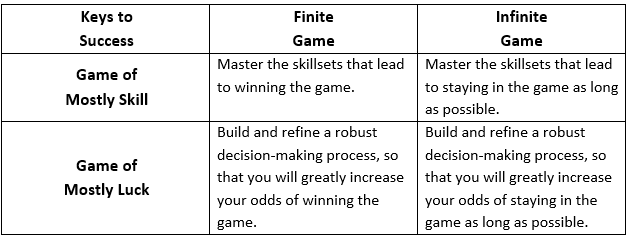
When determining where a game lands in the table above, there’s a few questions you can use to help you figure out what the key to success is.
Finite/Infinite Games:
Does the game have an ending where someone definitively wins?
If you achieve your end goal, does the game end?
Skill/Luck Games:
How much of the game’s outcome is determined by a player’s actions?
Can players repeat the same action and have different results?
Remember: games can be 100% skill, 100% luck, or any combination of both. They will usually lean one way or the other, but in some situations, it may make sense to classify the game as both.
Step 3 – Think of Repeatable Actions (Goals):
After you determine the key to success for the game you are playing, your next step is to think of repeatable actions that will help you to achieve that success. These are normally the S.M.A.R.T. goals that people set for themselves. The main differentiator here is that the goals you set need to be repeatable actions. You can start with generic, non-repeatable goals, but then ask yourself, what repeatable actions are needed to achieve those generic goals.
One thing to note, is that in games of luck, emotions and psychology are often involved. So, when you are creating goals around a robust decision-making process, you will want to include things that can help to keep your emotions in check. You may not think of everything ahead of time, and that is OK. When something unexpected does go wrong, think of a way to mitigate it in the future and implement that into your process.
Step 4 – Break Actions Down into Mini-Actions:
After coming up with your repeatable actions, you’ll need to break them down into mini-actions. The reason for this is that you’ll need to create new habits in order to be successful. And by performing your mini-actions repeatedly, you will create those new habits.
Mini-actions are loosely defined as being the most simplified version of your repeatable action, and generally take less than 30 seconds to perform. Ideally, they are performed at least once a day. In addition, you should be able to perform them even when you have zero motivation to do so. They should be tiny enough that even when you are having your worst day, you can still do your mini-action.
One exception when breaking down your actions is for games of luck. Sometimes you cannot easily break down your decision-making process into mini-actions. In these situations, you can substitute them with the question of, “Can I shorten the steps of my process to increase your odds of winning or staying in the game?”
Goals Set…Now Let’s Set Expectations:
After walking through the mental framework, the next step is obviously to start performing your mini-actions. This however, is much easier said than done. Life, emotions, and psychological roadblocks, can all get in the way. So, in order to be successful, you’ll need to remember some key things, and also to level-set your expectations. Below are some points to remember.
As a general rule, it takes 60+ repetitions to form and lock-in a new habit. This is why your mini-actions should be so easy that they can be done in 30 seconds or less, each day.
In the beginning of creating a new habit, do not focus on achieving your goal. Instead focus on locking in your new habit first. The results will slowly compound, and then exponentially increase after your habit is formed.
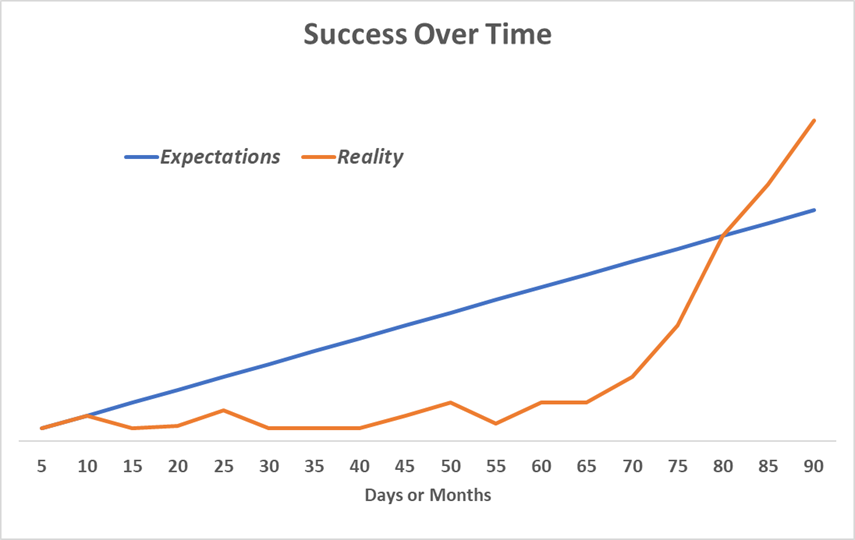
Remember, your key to success for infinite games is not to win the game, but to remain in it as long as possible. Use your mini-actions to do this. Strive for your original goals, but keep the focus on performing your mini-actions to just stay in the game.
Think of finite games as you getting to play on offense. You can go directly for the win. At the opposite end, you absolutely must think of infinite games as having to play on defense. You need to stay in the game as long as possible.
In games of luck, you must acknowledge ahead of time that things will not go your way. Ask yourself, what will your process be for handling these situations? Planning ahead will greatly reduce any negative consequences and psychological factors that might affect you, and you will be able to stay in the right mindset when the time comes. Also, ask yourself how you will know when you need to change your process?
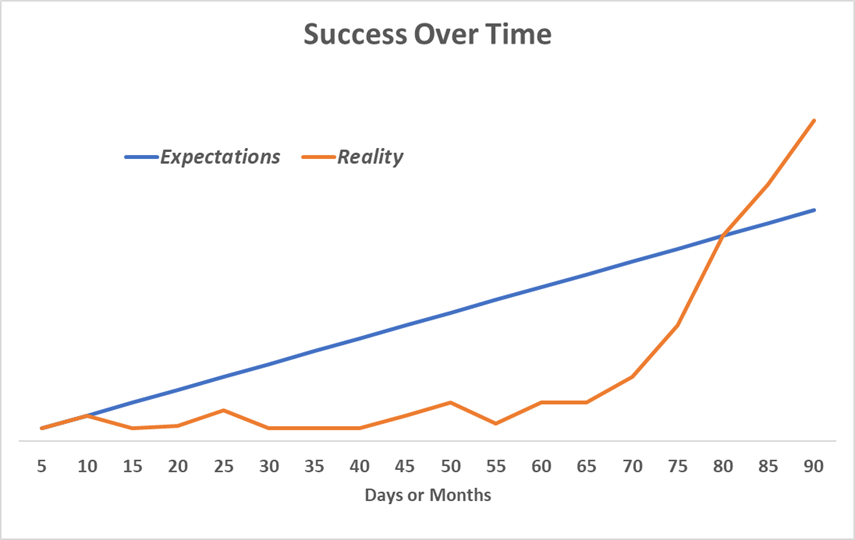
These are just some of the key points to remember. The main point is that you need to acknowledge reality. There is what you would like to do, but then there is what life will allow you do. So, level-set your expectations by making sure that they match the game you are playing.
In-Depth Examples:
To review the framework in full, we’ll walk through two in-depth examples.
A) Fitness:
Determine the type of game being played.
Does the game have an ending where someone definitively wins?
No, so fitness is an infinite game.
How much of the game’s outcome is determined by a player’s actions?
95%+, so fitness is a game of skill.
Identify the key to success.
Fitness falls under infinite and skill-based, so the key to success is,
Master the skillsets that lead to staying in the game as long as possible.
Think of repeatable actions that will help you to achieve the key to success.
Walk 10,000 steps per day.
Go to the gym 3 x week.
Exercise for 30 minutes 3 x week.
Break down your actions into mini-actions.
While all of the actions are relevant, the best one to start of with is exercise for 30 minutes 3 x week. And the mini-action for this can be simplified down to exercise for 30 seconds every day. The reasoning for this is explained below.
For fitness, people are generally good about setting repeatable actions as their goals. Where they fall on their face, is they fail to realize what game they are playing. Fitness is an infinite game, so the focus needs to be on playing defense, and staying in the game. This means focusing on performing mini-actions. In the midst of the game, you may have no motivation or willpower on 13 out of 14 days, and that is OK. Performing your mini-action on those 13 days will keep you in the game until your motivation returns.
To counteract any lack of motivation, the best actions should be generic, flexible, and have zero roadblocks. Using the examples above, walking a certain number of steps is very doable, but very specific and could become monotonous over time. Also, generally walking occurs outside and the weather could get in the way of this. Going to the gym is in itself a major roadblock, since it requires changing clothes, traveling, and then showering after. People are usually limited in the time slots also. So neither of these fully work. Exercising is good because it is generic. Both of the other actions can be defined as “exercising” themselves. So walking might be your exercise of choice and when it rains, you do some exercise inside. Therefore, there’s no roadblocks.
The mini-action can be shortened to exercising for 30 seconds a day. The only possible mental roadblock is thinking of exercise as having to jump or run around, which can be daunting. So, to mitigate that, you can change your mini-action to, Do 2 x pushups every day, or do 2 x squats every day. It’s quick and easy, can be done anywhere, and it will keep you in the game.
So, with all that, you should strive for exercising for 30 minutes 3 x week, but your main goal is to simply stay in the game by doing 2 x pushups every day. You then only lose the game by deciding to drop out.
B) Day Trading (Also applies to Investing):
Determine the type of game being played.
Does the game have an ending where someone definitively wins?
No, so day trading is an infinite game.
Can players repeat the same action and have two very different results?
Yes, so day trading is a game of luck.
Identify the key to success.
Day trading falls under infinite and luck-based, so the key to success is, build and refine a robust decision-making process, so that you will greatly increase your odds of staying in the game as long as possible.
Think of repeatable actions that will help you to achieve the key to success.
Keep a journal of your trades, along with the setups you used, and the circumstances of when you took the trade.
Follow a system for handling trades that go bad, and for trades that go well. Your system should emphasize risk management though.
Follow a system that mitigates any psychological traps you might fall into and helps eliminate emotions.
Break down your actions into mini-actions.
Day trading is a situation where you will most likely have a process that cannot be easily broken down into mini-actions. So, in this situation, do two things:
Build and refine your trading process by using small position sizes to start out with.
Ask yourself on every trade, what is your plan, and what steps will increase your chances of staying in the game as long as possible. Checklists can help for this.
Day trading/Investing is very subjective. Everyone will have their own methods, and you will find hundreds of indicators and strategies out there. Whatever system you choose, you must remember that the key to success is to stay in the game as long as possible. Because of this, risk management is paramount, as it is also your main point of control.
The other point to keep in mind is that day trading is very emotional and psychological. You will need to incorporate some psychological checks into your process. This is not easy and will take a lot of practice to form good habits. With all this in mind though, below are some basic concepts that you might use to build your process.
Preplan your trades and then stick to your plan. Journal everything.
Stop and ask yourself, why are you taking the trade now?
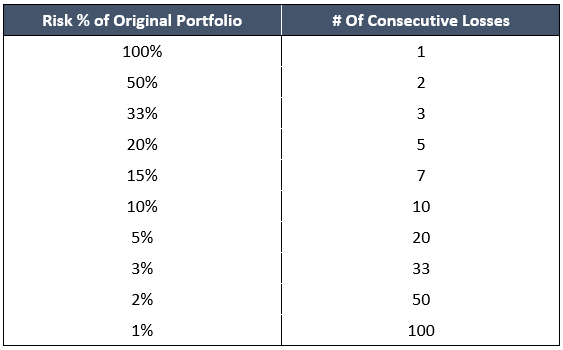
Risk only 1-3% of your portfolio on each trade. It will keep you in the game much, much longer. Below is a chart that shows how many consecutive losses you can sustain based upon the amount of risk you take for each trade.
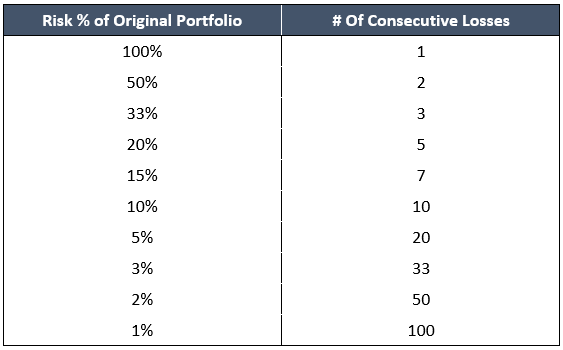
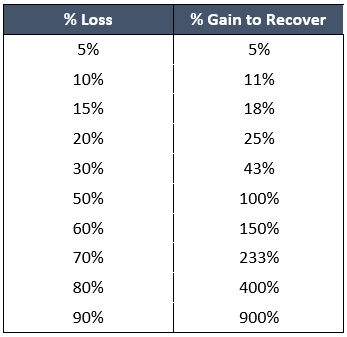
Risk management is paramount. Losses are much more damaging to a portfolio than gains are to building it. Below is a chart that shows the percentage gain you need to recover from a specified loss percentage.
Human nature is to get out of winners and then pile onto losers to prove you are right. When we don’t do this, it can get very uncomfortable. But that is exactly what you need to do…get uncomfortable. So instead of taking profits, you might add to position if your system warrants it, but leave a winning trade alone. Conversely, cut your losers as early as you know they are losers. Forget about being right. You could be correct about your thesis, but remember being too early to a trade is equivalent to being wrong. Timing is everything.
Beware of spikes in price which will anchor you to a price point. So, when price falls quickly, you view it as “on sale”. Likewise, when price rises quickly, you view it as “expensive”.
Imagine you are an athlete. You can’t play every day. You need to recover. So, you do not be in the market every day. Or if you prefer surfing as a metaphor, imagine you are out on a surfboard looking for a solid wave to catch. You intuitively let smaller/bad waves go by. You patiently wait for your wave to come in. In the same way, you should let sub-optimal setups pass by, and patiently wait for your ideal setup.
When you’re in a slump, ask yourself, what happened when the slump first started? Chances are that there was some event, often non-trading related, that triggered your slump. Walk through the events around when your slump started, and your subsequent actions to see if you can pinpoint the source.
Summary:
Re-read this until you intuitively understand the game types and keys to success for the most common games in life. Almost everything in life can be classified as a game in this context. Use the framework and build your skills. To help, below are some abbreviated examples of life’s games.
Diet/Nutrition is an infinite and skill-based game. Stay in the game by eating at least 1 vegetable a day. Since the game is very psychological, try to catch yourself by asking, why are you eating right now? Does it lead to the future you want?
Business is an infinite game. It is usually skill-based, but there are elements of luck also. Are the goals for your business finite such as “increase sales by 10%”, or do they match the game and are infinite, such as “get every customer’s feedback”?
Relationships are an infinite game and 50/50 skill-to-luck. Do you regularly check in with those close to you, or do you only contact them when you need something? Relationships can also be very psychological. For every 1 negative interaction, you need 5 positives to offset it. The luck part is you can’t control what the other person does.
Even something as simple as driving is a game. It’s is a finite game and probably 60/40 skill-to-luck. You control how you drive, but you do not control the thousands of drivers on the road, making hundreds of tiny decisions. Most of the process you might use is already set by traffic laws though, so you have a solid base when you first start.
Good luck!
…or skill.
References:
The Infinite Game by Simon Sinek (also James Carse)
The Success Equation by Michael Mauboussin
The Power of Habit by Charles Duhigg